

Strategy Safari: Book Insights and Applications
Originally published October 2022. Revised October 2026.
I found Strategy Safari useful because it explains why capable people can look at the same business and disagree about what to do next. They may be using different assumptions about how strategy is made: through analysis, formal planning, a leader’s judgment, or learning from experience.
The book, by Henry Mintzberg, Bruce Ahlstrand, and Joseph Lampel, examines ten schools of strategic thought. These notes focus on six perspectives I found useful, followed by my own interpretation of how to apply them. The point is to recognize what each perspective helps us see and what it tends to leave out.
Design: does the business fit the opportunity?
The design school treats strategy as a fit between an organization’s internal capabilities and its external environment. SWOT is a familiar tool for organizing that comparison.
For me, the harder work starts after the four boxes are filled. Calling something a strength does not establish that customers value it, that competitors cannot match it, or that the organization can use it profitably. An experienced team may be a strength for one opportunity and poorly suited to another.
I would use the exercise to make a specific choice explicit: given our capabilities and constraints, which opportunity should we pursue, and what should we leave alone? A useful diagnosis should change where time and money go. Otherwise, the exercise has produced a description rather than a decision.

SWOT Analysis
Planning: turn a choice into commitments
The planning school emphasizes a formal process: breaking strategy into objectives, programs, budgets, and controls. It helps explain how an organization coordinates activity once a direction has been chosen.
I see its value most clearly in dependencies. A distribution plan, for example, needs someone responsible for suppliers, inventory, working capital, and delivery. A missed dependency can make an attractive commercial idea unworkable. Formal planning makes those commitments visible and gives people a common basis for coordination.
The danger is false precision. A detailed spreadsheet can make uncertain demand look settled. I would distinguish commitments we control from assumptions we need to monitor. Hiring a person is a commitment; a forecast of customer uptake is an assumption. The plan should state what happens if that assumption fails, including when to slow spending or reconsider the decision.
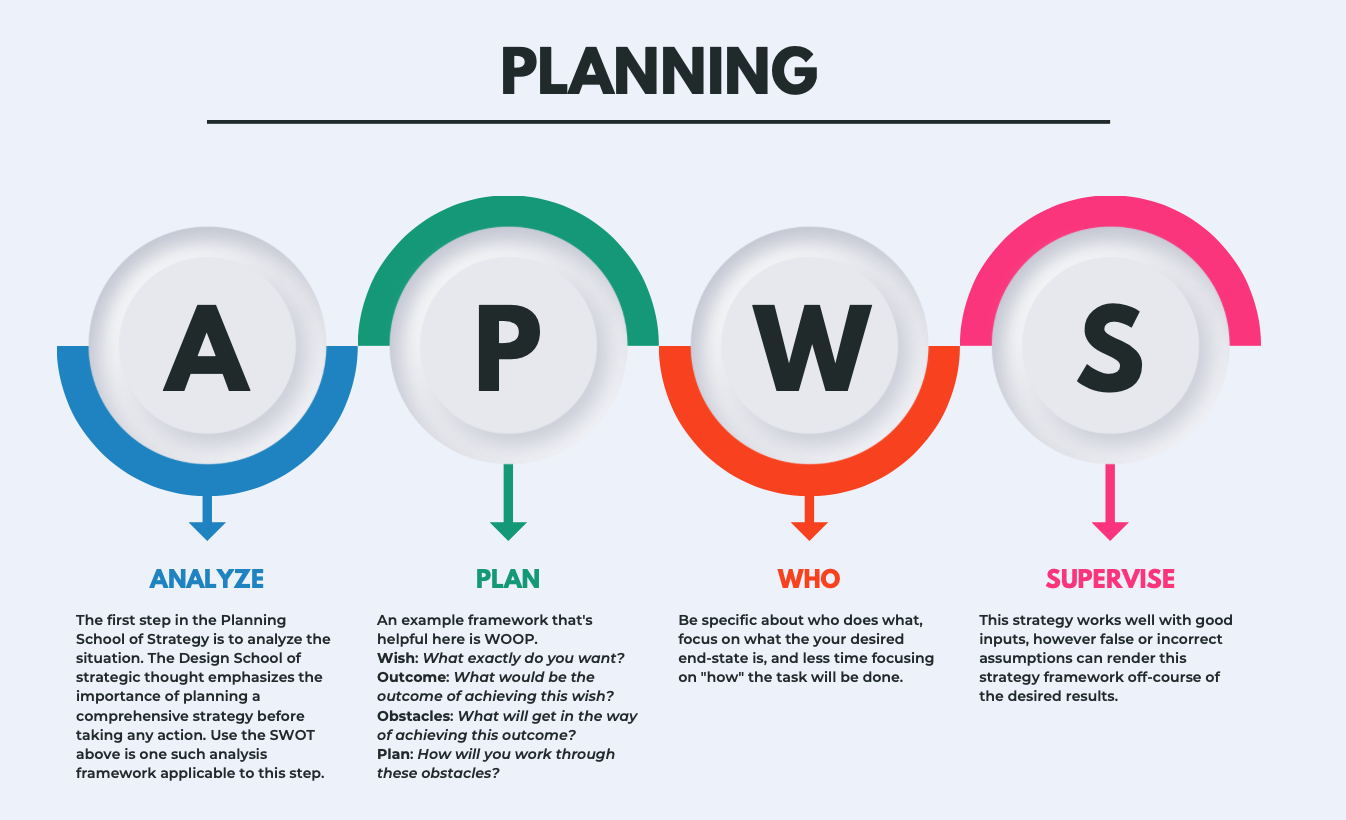
Planning Strategy
Positioning: examine the economics
The positioning school uses analysis of industries and competitive positions to inform strategic choices. It directs attention to the environment in which a business must earn its returns.
My practical question is where value can be captured and defended. A growing market can still be difficult if suppliers control the scarce inputs, customers can switch easily, or competitors continually undercut prices. I would want to understand those conditions before treating market growth as an investment case.
Analysis also needs a view of execution. A position that looks attractive on paper may require a sales channel, operating capability, or amount of capital that we do not have. I would test the market argument and the capability argument separately, then examine whether they fit together. A good market does not automatically make a good business for us.
Vision and concentrated authority
Another perspective in the book emphasizes a leader’s vision and judgment. A clear direction can allow an organization to act before there is enough evidence for a comprehensive plan.
That concentration of authority has a practical trade-off. It can reduce delay, but it can also make the business dependent on one person’s interpretation. Confidence is especially difficult to assess from inside a team when the person making the decision also controls which information receives attention.
I would look for clear ways to challenge the central assumptions. Who can raise contrary evidence? Which decisions can the team make independently? What result would cause the leader to change course? Those questions matter more to me than whether a leader can tell a persuasive story. The organization needs a direction and a way to correct it.
Cognition: examine the assumptions behind the argument
The cognitive school looks at the mental processes through which people interpret information and form strategy. Our experience helps us recognize patterns, but it also shapes what we notice and what we dismiss.
This was the most useful part of the book for me. It brought to mind disagreements with colleagues where we were arguing about a recommendation without examining the assumptions underneath it. Someone focused on liquidity may see a proposal very differently from someone focused on long-term capability. Both can be reasoning carefully while answering different questions.
A better discussion would separate observations from interpretations. “The customer has not reordered” is an observation. “The customer no longer needs the product” is one possible explanation. Price, timing, procurement rules, or a change in personnel could explain the same event. Making those alternatives explicit gives the team something to investigate.
I also find process mapping useful here. It can show where a decision depends on a habit or an unexamined assumption. The map does not settle the argument, but it makes the reasoning easier to inspect and gives colleagues a more concrete place to challenge it.
Learning: make experience change the decision
The learning school sees strategy emerging through experience, including patterns in actions that were not fully planned in advance. Formulation and implementation can inform one another.
I take that as a reason to design better feedback. Trying several things is only useful if we can tell what happened and adjust our decisions accordingly. Before a small commercial trial, I would specify the assumption being tested, the cost we can accept, the evidence we need, and the date for a decision. Otherwise, a trial can continue indefinitely because every disappointing result has another explanation.
The appropriate experiment also depends on reversibility. Testing a sales message is relatively easy to undo. A long lease, a plant, or a major equipment purchase creates obligations that persist after the initial idea changes. I would seek cheaper evidence before making the larger commitment, while recognizing that some uncertainty will remain.
How I would use these perspectives together
I would start with the decision itself. Are we choosing a market, allocating capital, coordinating an operation, or trying to understand an unexpected result? The useful perspective depends on the problem.
For an investment or operating decision, my sequence would be:
State the choice. Identify the alternatives and the constraints, including what we will decline.
Test the fit and the economics. Examine demand, bargaining power, capabilities, and the resources required.
Expose the assumptions. Record what we know, what we infer, and where colleagues disagree.
Make a proportionate commitment. Set responsibilities, budgets, dependencies, and decision rights.
Review against evidence. Decide in advance which results justify continuing, changing, or stopping.
These are my applications of the ideas, not a formula taken from the book. The book’s value for me is that it makes strategic disagreements more understandable. Before defending my preferred answer, I can ask what kind of problem the other person believes we are solving. That is a more useful starting point for a decision.